

Our Parish
Our Parish Today
A Vibrant Growing Community
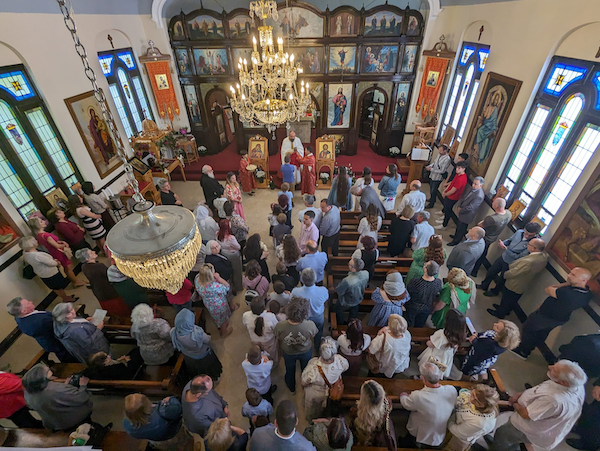
Welcome to the Serbian Eastern Orthodox Church-School Parish “Holy Trinity” in St. Louis, Missouri. We are a parish of the Serbian Orthodox Church in the Diocese of New Gračanica–Midwestern America, under the omophorion of His Grace Metropolitan Longin.
Our parish grows through worship, fellowship, and service, as we offer the following programs:
- Sunday School (free of charge) for children through age 13
- The Folklore Group (free of charge) teaches traditional Serbian folk dance to children ages 5-13.
- The Holy Trinity Choir, which sings the responses at the Sunday Divine Liturgy
- Kolo Srpski Sestara (Circle of Serbian Sisters), our women’s auxiliary dedicated to parish service and fellowship
- Youth Catechism, where young adults explore the teachings and traditions of the Orthodox faith
- Stewardship, mission that strengthens our parish family through fellowship and community service
We invite you to join us for Divine Liturgy on Sundays at 10:00 AM and to visit our calendar for additional services and events. Whether you are a lifelong Orthodox Christian, exploring the faith, or simply visiting, you are warmly welcome. We look forward to meeting you and sharing the life of Christ with you.
Our Parish History
A Rich Past of Culture and Faith
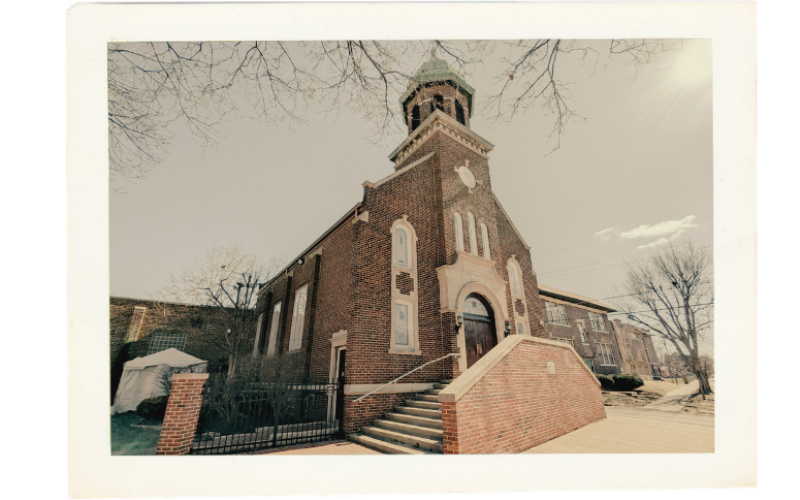
Founded by Serbian immigrants who arrived in the United States in the late 1800s and early 1900s, our parish was formally established on August 1, 1909. Through faith, sacrifice, and perseverance, this small but determined community built a spiritual home for future generations. Holy Trinity Church, located at 1910 Serbian Drive in the McKinley Heights neighborhood of south St. Louis, was consecrated on June 2, 1928. The adjacent Serbian Hall was blessed on April 13, 1947, further strengthening our parish life.
Over the decades, new waves of immigrants—including refugees following World War II and families displaced during the conflicts of the 1990s—renewed and enriched our community. Each generation has brought fresh energy and devotion, helping Holy Trinity remain a vibrant witness to the Orthodox Christian faith.
A Letter from Holy Trinity Church Board President
The Beginning of Holy Trinity Serbian Orthodox Church in St. Louis

According to written records, the first Serbian immigrants came to St. Louis from the most northern part of Serbia, Marindal, in what is sometimes referred to as “The Old Country”. By the turn of the century, they immigrated here from Banat
in 1902; from Like and Kordum in 1904; from Hercegovina; in 1906 from Bosnia, Cerna Gora, Slavonia and Srem, and from the Kingdom of Serbia.
They organized a singing group named “Gusla” in 1908, and the tamburitza orchestra “Serbska Vila”. Thus began the discussions to build a Church-school congregation. Committees were formed, plans were laid, invitations were sent out, and an all-Serbian meeting was held on August 1, 1909.
Elected as the first president was Ivan Lakich owner and editor of a Serbian newspaper “Buducnost” (Future). There were many others who served on the board whose names are now long forgotten, along with the names of the Priests who faithfully served this Parish.
In 1910 Holy Trinity celebrated St. Sava’s Day” in the spirit of love of freedom, patriotisms and love of God. Also, in 1911 they purchased a building on Eighth and Barry Avenue. It held enough rooms for all Church services, Sunday School and many other social activities.
Just before the group “Gusle” was established, there were only 45 states in the Union at the time. Oklahoma had entered the United States on November 16, 1907. This would then be followed by New Mexico entering the Union on January 6, 1912. Arizona would follow on February 14, 1912. The United States was a young country still in its formation. Holy Trinity was a prayer that was about to be answered.
The 1904 World’s Fair Exhibition closed on December 1, 1904. The birdcage at the Zoo is the original birdcage from the Fair that is still in existence today. Reportedly the first ice cream cone, the first hot dog, and the first iced tea were served at the Fair.
The first Kindergarten was established in St. Louis by Susan Elizabeth Blow in 1872. In attendance were 13 children with quarterly dues of one dollar.
Other events happening in the world around the turn of the century included the Wright Brothers, who flew their first experimental flight at Kitty Hawk in 1903.
On June 16, 1903, Henry Ford and 12 others invested $28,000 and created Ford Motor Company. The first car built by the Company was sold on July 15, 1903. Ford’s very first car, however, was built in 1896. He called it the “Quadricycle”.
In 1905, the first dedicated gas filling station in the world was opened here in St. Louis on 420 South Theresa Avenue. That same year Washington University moved to its present location. Our famous St. Louis Zoo was established around 1913. And the outdoor Municipal Opera, now commonly known as the Muny, would open in 1919.
The trade up and down the Mississippi River helped St. Louis to become what is called “The Gateway to the West”. The river would bring paddle-wheelers, steamships, packet freighters, showboats and a host of other river vessels bringing goods to trade in St. Louis.
On October 11, 1910, Theodore Roosevelt Jr. was the first President of the United States to fly aboard an airplane that was built by the Wright Brothers. This took place at a location in St. Louis called Kinloch Field. Originally the field was a balloon launching base that started in 1890. In 1923 Kinlock Field became Lambert-St. Louis Flying Field. This field would later, in 1930, be renamed Lambert Municipal Airport.
The Lambert name comes from a gentleman named Albert Bond Lambert (1875-1946). He learned how to fly under the direction of the Wright Brothers. He served as a pilot in World War I where he was awarded the rank of Major. He was one of the early founders of the St. Louis Flying Field. In 1920 he leased 170 acres of land to serve as an airfield for St. Louis. Through his own efforts and money, he took on the responsibility of obtaining and clearing land for use. Twenty-one years later a pilot named Charles Lindbergh visited St. Louis and decided to stay and became a flight instructor there. Later a contract was awarded from the Post Office to begin an air-mail route from St. Louis to Chicago. Charles Lindbergh was hired as the chief pilot. This would become the earliest predecessor of American Airlines.
At the turn of the century, St. Louis was one of the leading cities in the country. It had the largest brewery (Anheuser-Busch), the largest tobacco factory (Liggett & Meyers), and the largest drug house (Meyer).
Located in St. Louis at the time were twenty-one banks, thirty-two shoe factories and thirty-eight fire companies. St. Louis was first place in building carriages, buggies and wagons. Also, there were twenty hospitals, fifty furniture factories, four cable railways, twenty streetcar lines and nine daily newspapers. The Post Dispatch and the Globe Democrat were two that were among them.
Bevo Mill was opened on June 19, 1917. It sits on what was originally a Native American trail to a salt spring. The Busch Family built it for their own pleasure and to serve as a tourist attraction. Who would know that years later one of our own parishioners, Louis Lauesevich, would at one time be a part owner of that restaurant.
Last, but not least there were about two hundred and fifty Churches in St. Louis around the turn of the century. Holy Trinity was no more than a dream for a few immigrants that wanted to have a place to remind them of home.
In 1902 Sportsman’s Park was opened for major league baseball with a seating capacity of 8,000 fans. The park was renovated in 1909 to expand the seating capacity to 17,600. Both the St. Louis Browns and the St. Louis Cardinals shared the park. It was a well-known fact that the Brown Fans drink of choice was Falstaff Beer while the Cardinal Fans favored their Budweiser.
One of our own parishioners, Boris Martinovich, called Babe Martin, played for the St. Louis Browns. And another Serb, Ely Vujnich, would play on the Browns farm team as a left-handed pitcher.
Those are just a few of the many interesting historical facts of St. Louis. As you can tell, a lot has changed since then.
We’ve been through the Great Depression, countless recessions and World Wars. These events no doubt had a great emotional and financial impact on our Church family. There have been political changes and civil rights movements. Added to that, the challenges we all face in normal everyday life.
When called upon, our men and women volunteered their lives in defense of our country. Hanging in the office upstairs at Holy Trinity is a flag containing the names of the men and women who served during World War II. St. Louis played a major part producing much needed supplies for the Armed Forces and our Allies.
International Shoe Co. alone produced over 43,000,000 pairs of shoes for the Armed Forces and our Allies. Schlueter Mfg. Co. made over one half of all the Armed Forces helmets. The St. Louis Ordinance Plant turned out 6,738,009,746 rifle and machine gun cartridges. The plant employed 86,294 men and women. Pevely Dairy, located at Grand and Chouteau, who’s history spanned over 115 years, produced dehydrated eggs for War Effort. The number of businesses whose contribution to the Armed Forces that were located in St. Louis are too numerous to mention. They worked on a twenty-four-hour basis and were not allowed to strike.
We cannot forget the importance of Jefferson Barracks. When the first American Flag was raised in Jefferson Barracks there were only twenty-four states in the Union. In 1940 it was the largest Army Air Corps training base in the country.
Through it all, for the last one hundred and fifteen years, Holy Trinity has managed to survive. It may not always have been easy at times, but together our people have found ways to work out the differences that will always arise when change and working to achieve progress is inevitable.
The doors of Holy Trinity have been and will always be open to everyone. The stories are endless of those who left their homes and families to come here for a better life. Currently we have sponsored 35 children from Serbia who come here in need of life changing operations, and any more are sure to follow. It’s hard to imagine that our little community would have that far reaching influence.
As you enter the Church and the hall, it’s easy to see the pride we’ve taken to maintain and improve our surroundings. The renovation of the grounds and hall are stunning. It has enabled us to rent the hall for supplemental income.
Despite all the political and cultural changes that surround us, we have kept our Orthodox Faith. We have maintained the heritage that has been handed down to us, and it is incumbent on us to keep and pass on that heritage to future generations. We are the custodians of our own destiny. By the giving of our talents, our time and our treasure, we will be able to keep alive what has been entrusted to us.
Since the formation of Holy Trinity, the city and life itself have changed dramatically. Most of those early businesses are gone. And if you drive around the city within a couple of miles radius of our Church, you’ll find that many of those early Churches are shuttered, empty, in dis-repair or sadly neglected. If they were fortunate enough to survive, they more than likely changed denominations.
We are proudly still here. We are alive and active. Our Faith and Traditions unite us and bind us together. Whatever changes may occur, and there will be changes, we are thankful to those who have been willing to step in and fill in the gap when needed. We have been very blessed to have people who make that sacrifice for the good of our Church.
If you are looking for a Church, we invite you to visit. If you have been away, for whatever reason, we welcome you back to renew old friendships.
May God grant us many more years.
Sincerely,
Michael Vujnich, Holy Trinity Serbian Orthodox Church Board President